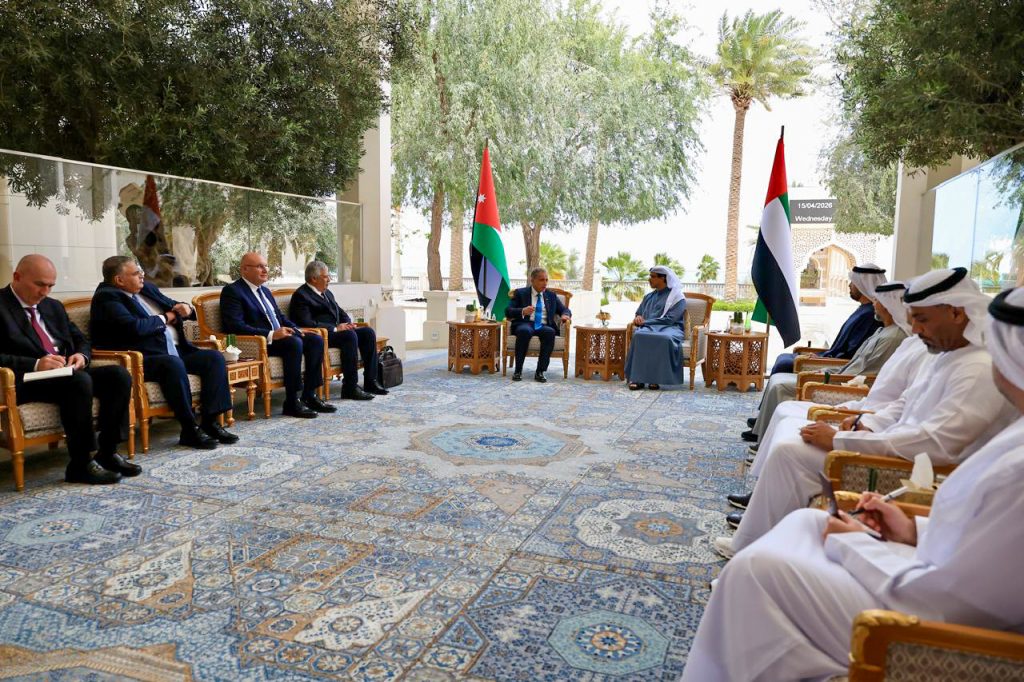
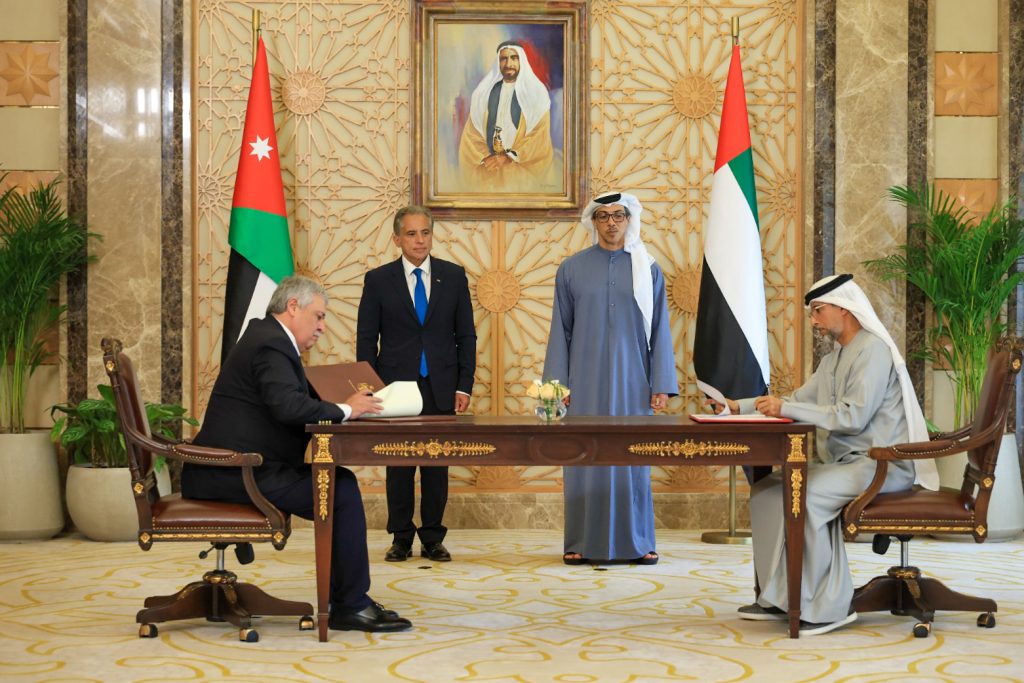
Prime Minister Dr. Jaafar Hassan and His Highness Sheikh Mansour bin Zayed Al Nahyan, Vice President of the United Arab Emirates, Deputy Prime Minister and Minister of the Presidential Court, witnessed the signing of agreements to initiate the implementation phase of the Aqaba Port Railway Project and to establish a joint Jordanian–Emirati company responsible for constructing and operating the railway.
The project is based on an equal partnership between Jordan—represented by the Jordan Phosphate Mines Company, the Arab Potash Company, the Government Investments Management Company, and the Social Security Investment Fund—and the UAE, represented by LIMAD Holding, the sovereign investment platform affiliated with the Abu Dhabi government.
Valued at approximately $2.3 billion, the project is the largest railway transport initiative in the Kingdom. It includes a comprehensive package of major infrastructure works, such as railway lines, tunnels, and bridges, designed and implemented in accordance with the highest international standards in the rail sector.
The project is expected to enhance the economic competitiveness of the Port of Aqaba, positioning it as a strategic regional gateway for transport, shipping, and logistics services. It will also unlock wide-ranging development opportunities across the Kingdom, particularly in the southern governorates and the Jordan Valley.
This step marks the first phase in building Jordan’s national railway network, which aims to connect Aqaba with neighboring Arab countries and link the port to Syrian and Mediterranean ports.
The project builds on the broader $5.5 billion joint investment agreement signed between the two sides at the end of 2023, in the presence of His Majesty King Abdullah II bin Al-Hussein and His Highness Sheikh Mohamed bin Zayed Al Nahyan.
It is expected to stimulate key economic sectors and bring about a structural transformation in the transport and logistics sector by enabling direct connectivity between mining sites and ports, reducing transportation costs, improving supply chain efficiency, and increasing exports of phosphate and potash.
The project will serve as a major driver for the mining sector, enhancing its operational efficiency and strengthening the economic value and competitiveness of related industries.
It also represents a foundation for future expansion toward the Madhouneh area and northward to Syria, linking Aqaba to Mediterranean ports via Syria and Turkey, and onward to Europe. In addition, it will strengthen connectivity with Saudi Arabia and the Gulf countries, contributing to enhanced Arab economic integration and reinforcing Jordan’s position as a regional transport and logistics hub.
The project includes the construction of a 360-kilometre railway network connecting phosphate and potash mines to the industrial port through two main routes serving production sites in Al-Shidiya and Ghor Al-Safi.
Approximately 16 million tons of phosphate and potash will be transported annually via the railway network, including around 13 million tons of phosphate and 2.6 million tons of potash, significantly enhancing export capacity and boosting the competitiveness of the mining sector in Jordan.
The government has also initiated studies to extend the railway line from the Al-Shidiya mining area to the Ma’an Development Area, in alignment with plans to establish a Ma’an–Aqaba dry port as a nucleus for a new logistics, customs, and industrial zone.
Financial close for the project is expected in early 2027, with implementation scheduled over a five-year period according to a clear execution roadmap.
The project will generate direct and indirect employment opportunities across the transport, mining, and logistics sectors, while opening new development horizons.
The government will allocate the necessary funds to compensate landowners whose properties will be acquired in the Jordan Valley for the purposes of the project or provide fair alternative land.
The project is being implemented in partnership with LIMAD Holding, which will transfer advanced technical expertise in railway development and operations, while contributing to building specialized national capacities in the rail sector.
On the sidelines, Prime Minister Jaafar Hassan and Sheikh Mansour bin Zayed held a meeting, emphasizing that the agreements reflect the deep-rooted relations between the two brotherly countries and come within the framework of a broader strategic partnership across multiple sectors, particularly in economic and investment cooperation.